Desert Online General Trading LLC
Dubai, United Arab Emirates
Desert Online General Trading LLC
Dubai, United Arab Emirates

Full description not available
M**.
Highly Recommended
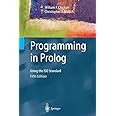
Programming in Prolog is a clear, precise introduction to Prolog from the ground up.While is does start with the basics, it is an incredibly thorough text, covering all minutia of the language. The text is clear, easy to understand, and to the point, moving quickly through topics without sacrificing understanding.I used this book as a supplementary text in an upper-division college course. After reading only the first four chapters, I knew things about the language that the instructor did not.I highly recommend this book to any programmer of any skill level that is interested in learning the Prolog programming language.Additionally,The following two books were recommended in the preface of Programming in Prolog. The first as a quicker (though not as complete) overview for the experienced programmer, and the second as a language reference.Clause and Effect: Prolog Programming for the Working ProgrammerProlog: The Standard: Reference Manual
W**L
Perfect introduction to Prolog
I went with the reviews that stated that this is the gold standard for learning Prolog and I was not disappointed. While some books on code have you searching for better, working examples on Google; this introduction included all working code organized in a logical and thoughtful manner. Only criticism I would have is that it goes on a little long at times on the theory of the workflow in Prolog, although there may be some people out there who are really interested in this aspect. If you are interested in logic programming at all pick this book up.
P**O
advisable
good, synthetic and very well written
W**E
Excellent core text on Prolog
This is the "KnR" of Prolog programming. It has the same diversity of style that some people who might want a "how to program Prolog in 24 hours" approach won't appreciate. It covers the basis of the language however in a way that ties together, as all good programming reference books do, the fundamental reasoning that went into the language and how to use it effectively in the way it was meant to be. Great to read on Kindle app.
A**R
The Best Book on Prolog
As good in 2007 as it was when published first time. There is no better introduction to Prolog
J**H
Dissatisfied
Pros:- Even someone with no programming or math knowledge could pick up the book, read it, and learn Prolog- Uses ISO-Prolog- Large section of helpful example programsBig Cons:(I'll give citations, only from the first 100 pages to keep things short, lest anyone think I am lying about the problems with the book)- Frequent syntax errors *in program statements* - in Prolog, every comma and period is absolutely essential, when they are missing it entirely changes the meaning of the statement - the book misses them pretty routinely (p 81, twice)- Frequent logic errors - in Prolog, the order of facts and rules is extremely important. The book commonly mixes things up, presenting you with programs that will not work (p 56 - note here that they are trying to give an example of what will/won't work, and they get it backwards)- Frequent editing/formatting errors - charts, diagrams etc are fairly often on the wrong page or in the wrong location, etc. (p 48)- Poor organization - looking through the table of contents, you would think the book is extremely well organized, but as you read it, you'll find new and important ideas thrown into random sections - if you forget something, and need to find it later, you'll probably need to re-skim the entire book. Things are almost never presented in convenient bullets/numbering, almost always in paragraph form, again, making essential ideas tedious to find.- Confusing - I have degrees in math and computer science, and have been programming for 15 years, and I still found parts of the book hard to follow - note that it had nothing to do with Prolog itself, which is actually very straightforward, but rather with the explanations given, which sometimes seem meandering and poorly worded.- A really short and crummy index makes things hard to find. For example, look up "atoms", a concept first mentioned on page 26, and routinely mentioned afterwards, a concept absolutely essential to understanding Prolog - the index shows that the first (and only) time it appears is on page 123.Average Cons:- Authors use an "arrow system" to trace Prolog decision making, I think a table system (which could easily show previous, current, and future steps, and details of each iteration) would have been better while presenting more information in a clearer fashion.- Code re-use - normally a good thing, frustrating in this book. You might have a rule (like a function) called "mother(X)..." early on in the book, not use it for 100 pages, and then it appears again. If you want to try the program out yourself, you'll need to know the exact definition of "mother(X)...". There's no way to find what page the function was on in the index or TOC, so you find yourself spending 30 minutes leafing through the book to find it. 99% of these are a single line of code, so there's really no need to reuse them, it's hardly saving any space.- Overly complex examples - sometimes the authors illustrate an idea with 20 lines of code, when 4 would have been sufficient. It makes for a lot of extra reading and deciphering.Small Cons:- (This could be a pro or con - since I don't know too many people who *start* their programming experience with Prolog, I assume the reader has some experience with programming, and so list this as a con) Book is far too detailed for someone with moderate programming or math experience. This helps some people, but makes it a tedious read for others. Every concept is thoroughly explained. If you're a programmer, this gets a little old during things like variables and recursion. If you know any math, verbose explanations of predicate logic will become tiresome. In fairness, it was no doubt the authors' intention to make a "complete" introduction to Prolog, and so it is hard to criticize this.- (Another pro/con, depending on the reader) British examples - the authors are British (or at least one of them is), and use British references in their code all the time (9th century princes of Wales, p 34; horses who won races in Britain in 1927, p 53) - if you're British this might break up the monotony and make things a little more interesting, if you're not, it just gets a little old, I'd rather see every example just use "cat","dog","mouse".Other:- NOT a good reference book (and it wasn't meant to be), if you know Prolog already and need a reference book, look elsewhere. This is for people who do not know Prolog.Conclusion:- I wish I bought a different book. BUT despite everything, I did adequately learn Prolog from this book, so will reluctantly give it 3 stars.
H**X
the prolog classic
Programming in prolog is an excellent book, good reference about the core of prolog and its Edinburgh implementation. This book contains all you have to know about the "core". Easy to understand and fast to read.
J**N
Good introduction into a complex topic
Prolog is hard. This will help you across the initial threshold.
Trustpilot
Hace 1 semana
Hace 1 mes